
All-on-4 Implant or All-on-6 Implant offer a way to replace an entire arch of missing or severely damaged teeth using implants placed in the jaw to support a fixed prosthesis.
But does having six implants make All-on-6 better than All-on-4? Not necessarily. The right option depends on factors such as your bone quantity and quality, jaw anatomy, bite, gum health, prosthetic requirements, general health and the way the implants can be distributed.
In this guide, we explain what full-mouth dental implants are, how All-on-4 and All-on-6 work, and how a dentist decides which approach may be appropriate.

Quick Answer: What Is the Difference Between All-on-4 Implant and All-on-6?
All-on-4 uses four strategically positioned dental implants to support a fixed full-arch prosthesis, while All-on-6 uses six implants to support the replacement teeth.
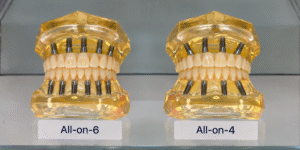
The number of implants is only one part of treatment planning. Bone anatomy, implant distribution, available space, bite forces, prosthetic design and long-term maintenance all influence the final decision. Research has not shown that All-on-6 is automatically superior to All-on-4 in every patient.
| Feature | All-on-4 | All-on-6 |
|---|---|---|
| Number of implants | Usually 4 per arch | Usually 6 per arch |
| Main purpose | Support a full-arch fixed prosthesis | Support a full-arch fixed prosthesis |
| Implant distribution | Strategically distributed, sometimes using tilted posterior implants | Usually allows wider implant distribution |
| Bone requirements | Can be useful when available bone is limited in certain areas | May require sufficient bone for additional implant positions |
| Is it better? | Not automatically | Not automatically |
| Best choice | Depends on individual anatomy and treatment plan | Depends on individual anatomy and treatment plan |
The important point
All-on-4 and All-on-6 are treatment concepts, not two universally ranked levels of treatment.
A careful treatment plan should determine how many implants are appropriate rather than choosing the number first.
What Are Full-Mouth Dental Implants?
Full-mouth dental implants are used when a patient has lost most or all teeth in one or both dental arches, or when the remaining teeth have a poor long-term prognosis.
Instead of replacing every missing tooth with an individual implant, a smaller number of implants can be strategically placed to support a complete fixed arch of replacement teeth.
This is different from placing one implant for every missing tooth.
For example, an upper jaw with no remaining teeth does not necessarily require 10–14 individual implants. Depending on the patient’s anatomy and treatment plan, a complete fixed prosthesis may be supported by four, six or another appropriate number of implants.
The final prosthetic design should be considered before implant placement. ITI consensus guidance highlights factors such as available bone, implant distribution, prosthesis material, available space, aesthetics, opposing teeth, hygiene access and patient preferences when planning complete-arch treatment.
If you are considering replacing multiple missing teeth, you can first read our detailed guide to Dental Implants in Gurgaon to understand how implant treatment works, who may be a candidate and what options are available.
What Is All-on-4 Dental Implant Treatment?
All-on-4 is a full-arch implant treatment concept in which four appropriately positioned implants are used to support a fixed prosthesis for an entire dental arch.
The posterior implants may be intentionally tilted in suitable cases. This can help make use of available bone and improve the front-to-back distribution of the implants without automatically requiring extensive bone augmentation in every patient.
However, tilted implants are not simply a shortcut or a technique that should be used for everyone. The decision depends on the anatomy and the prosthetic plan.
ITI consensus evidence reports no statistically significant difference in implant or prosthesis survival between axial and intentionally tilted implant configurations when used to support full-arch fixed dental prostheses.
Why might four implants be enough?
The goal is not simply to count implants. The goal is to create a stable foundation for the planned prosthesis.
Four appropriately distributed implants can provide support for a one-piece full-arch fixed prosthesis in suitable patients. ITI consensus guidance specifically recognises a minimum of four appropriately distributed implants for this type of restoration, while also stressing that the consequences of possible future implant loss and the overall prosthetic plan must be considered.
This is why the phrase “All-on-4” should not be interpreted as “four implants are always enough.”
The patient’s individual anatomy and treatment requirements still matter.
What Is All-on-6 Dental Implant Treatment?
All-on-6 uses six strategically positioned implants to support a fixed full-arch prosthesis.
The additional implants can allow a wider distribution of support across the arch. This may be useful in some patients, particularly when the available bone, bite forces, prosthetic design and overall anatomy make additional implant support desirable.
However, six implants are not automatically better simply because there are two more implants.
A larger number of implants also means additional surgical sites, additional planning considerations and the need for adequate bone and anatomy at those positions.
The decision should therefore be based on the complete treatment plan rather than on the number of implants alone.
All-on-4 Implant vs All-on-6: Which Is Better?
There is no single answer that applies to every patient.
A 2026 systematic review and meta-analysis comparing All-on-4 and All-on-6 found broadly similar clinical outcomes between the two approaches overall, although the authors noted substantial variation between studies and advised caution when interpreting the findings.
A separate retrospective study following 217 patients for 3–13 years also found no significant overall difference in implant or prosthesis survival between All-on-4 and All-on-6. However, All-on-6 appeared more predictable for certain patient characteristics, including some patients with lower bone density, smoking, bruxism or longer cantilever lengths.
This is why the better question is not:
“Is All-on-4 better than All-on-6?”
It is:
“Which implant configuration is better suited to my bone, bite, prosthesis and long-term needs?”
That is the question your implant dentist should answer after examining your mouth and reviewing appropriate diagnostic records.
Dr. Arjita Sood’s Clinical Tip
The number of implants should be decided after understanding the patient’s anatomy and the final prosthetic plan—not before. Two patients with similar numbers of missing teeth may require very different implant designs because their bone, bite, gum health and prosthetic requirements are different.
This is particularly important when comparing All-on-4 and All-on-6. A treatment plan should be based on what provides an appropriate foundation for the final teeth rather than simply choosing the option with more implants.
Does All-on-6 Last Longer Than All-on-4?
Not necessarily. Current evidence does not support the idea that All-on-6 automatically lasts longer than All-on-4 in every patient.
Both approaches can provide successful long-term full-arch rehabilitation when the patient is appropriately selected and the implants and prosthesis are properly planned, placed and maintained.
Long-term success depends on several factors, including:
- Implant position and distribution
- Bone quality and quantity
- Gum and periodontal health
- Bite forces
- Smoking
- Oral hygiene
- Bruxism or teeth grinding
- Prosthesis design
- Regular professional maintenance
A 2026 systematic review found similar overall survival outcomes between All-on-4 and All-on-6, although individual clinical circumstances can influence which approach is more predictable.
Key Takeaways
- Full-mouth dental implants can replace an entire arch of missing or failing teeth using a fixed implant-supported prosthesis.
- All-on-4 generally uses four strategically positioned implants per arch.
- All-on-6 generally uses six implants per arch.
- More implants do not automatically mean a better treatment.
- Bone anatomy, bite, prosthetic design, oral health and long-term maintenance all matter.
- The appropriate implant number should be determined as part of an individual treatment plan.
- A proper evaluation is more important than choosing All-on-4 or All-on-6 based on the name of the technique alone.
Who May Need Full-Mouth Dental Implants?
Full-mouth dental implants may be considered when most or all teeth in an arch are missing, severely damaged, or have a poor long-term prognosis.If you are still exploring your options for replacing missing teeth, our comprehensive guide to Dental Implants in Gurgaon explains the different implant treatments, candidacy, benefits, treatment planning and what to expect from the process.
They may be an option for people who:
- Have lost most of their teeth
- Have multiple teeth that cannot be predictably saved
- Struggle with loose or uncomfortable dentures
- Want a fixed alternative to removable dentures
- Have sufficient bone for implant placement, or may be suitable for treatment after bone augmentation
- Are medically and dentally suitable for implant treatment
However, having many missing teeth does not automatically mean that all remaining teeth should be removed.
If some natural teeth have a good long-term prognosis, preserving them should always be considered. ITI consensus recommendations specifically emphasise evaluating tooth preservation before planning complete-arch extraction and implant rehabilitation.
This is one reason a proper examination is more important than choosing an All-on-4 or All-on-6 package based only on the number of implants.
How Is All-on-4 or All-on-6 Treatment Planned?
Full-mouth implant treatment is not simply about placing four or six implants.
The final teeth should be considered before the implants are placed.
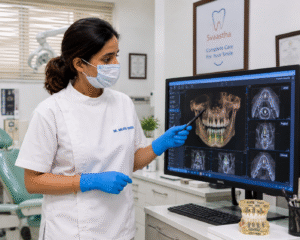
During treatment planning, your dentist may evaluate:
1. Bone quantity and quality
The available bone determines where implants can safely be placed and how they can be distributed.
2. Jaw anatomy
Important anatomical structures, such as the maxillary sinus and nerves in the lower jaw, need to be considered when planning implant positions.
3. Your bite
The way your upper and lower teeth meet affects the forces placed on the final prosthesis.
4. The planned prosthesis
The material, shape, number of teeth, aesthetics, hygiene access and design of the final prosthesis can all influence implant positioning.
5. Your smile and facial appearance
Full-arch treatment is not only about chewing. Tooth position, lip support, smile line and facial proportions can influence the final design.
6. Long-term maintenance
The final restoration should allow reasonable access for cleaning and professional maintenance.
ITI recommendations specifically state that the final prosthetic plan should be considered when developing the surgical plan for an edentulous arch. Factors include bone anatomy, implant distribution, cantilever length, aesthetics, available space, hygiene access and patient preferences.
Does Everyone Need Bone Grafting for Full-Mouth Implants?
No. Bone grafting is not automatically required for All-on-4 or All-on-6 treatment.
Some patients have enough suitable bone for the planned implant positions. Others may have bone loss because of previous tooth loss, gum disease, infection or prolonged denture use.
In selected cases, implant positioning can be planned around areas of available bone. In other cases, bone augmentation may be recommended to create a more suitable foundation.
The decision depends on the amount and location of available bone and the prosthetic plan.
A CBCT scan can provide three-dimensional information about the jaw and help the dentist assess bone anatomy before treatment.
Why is bone assessment important?
A patient may appear to have enough bone on a conventional dental X-ray but have a different situation when the width and height of the ridge are evaluated in three dimensions.
This is particularly important when deciding whether additional implants can be placed in certain areas.
ITI guidance notes that increasing implant number or distribution may sometimes require bone augmentation, which can make treatment more invasive.
All-on-4 vs All-on-6: What Actually Determines the Choice?
There is no universal rule that says All-on-4 is for one type of patient and All-on-6 is for another.
The choice may depend on several factors.
| Factor | Why it matters |
|---|---|
| Bone availability | Determines where implants can be safely positioned |
| Bone quality | Can influence implant stability and treatment planning |
| Implant distribution | Affects support for the planned prosthesis |
| Bite forces | Higher forces may influence the treatment design |
| Bruxism | Teeth grinding can increase mechanical demands |
| Prosthesis design | Different designs may require different implant distribution |
| Aesthetic requirements | Tooth and gum position affect the final appearance |
| Hygiene access | The restoration must be maintainable long term |
| Overall health | Medical conditions can influence implant treatment |
| Patient preference | Treatment should reflect informed patient choices |
So when someone asks, “Should I get All-on-4 or All-on-6?”, the correct answer cannot be given from the number of missing teeth alone.
It requires an individual assessment.
Is All-on-6 Always More Stable Because It Uses More Implants?
Not necessarily.
It may seem logical that six implants must always provide more support than four, but implant treatment is not determined by numbers alone.
The position and distribution of the implants, the available bone, the prosthesis design and the forces acting on the restoration all matter.
ITI’s review of complete-arch fixed prostheses found no statistically significant difference in implant survival associated with using fewer than five implants compared with five or more implants. The organisation therefore recommends that implant number be determined as part of the overall prosthetic and surgical plan.
More implants can be useful in selected situations, but more is not automatically better.
What Does Full-Mouth Dental Implant Treatment Cost?
The cost of full-mouth implant treatment varies considerably because it is not simply the price of four or six implants.
The final treatment estimate may depend on:
- Number of implants
- Implant system and components
- Temporary prosthesis
- Final fixed prosthesis
- Abutments and prosthetic components
- CBCT and other diagnostic procedures
- Tooth extractions, if required
- Bone grafting or other additional procedures
- Type and material of the final teeth
- Complexity of the bite and prosthetic design
- Follow-up and maintenance requirements
This is why comparing two treatment plans only by their total price can be misleading.
For a detailed explanation of the factors that influence implant pricing, you can read our guide to Dental Implant Cost in Gurgaon.
What should you ask before comparing two quotes?
Before choosing between two full-mouth implant treatment plans, ask:
- How many implants are planned and why?
- Which implant system is being used?
- What type of temporary teeth will I receive?
- What is included in the final prosthesis?
- Are extractions included?
- Is bone grafting included if it becomes necessary?
- Are diagnostic scans included?
- What happens if an implant does not integrate?
- How will the final teeth be maintained?
- What follow-up care is included?
A lower initial quotation does not necessarily represent a lower total treatment cost, and a higher quotation does not automatically mean better treatment.
The treatment plan behind the price is what should be compared.
Dr. Arjita Sood’s Clinical Tip
When comparing All-on-4 and All-on-6 treatment plans, don’t ask only, “How many implants am I getting?” Ask, “Why has this number been recommended for my particular mouth?”
A good treatment plan should explain the implant positions, the planned prosthesis, the available bone and how the restoration will be maintained over the long term.
What Happens Before the Implants Are Placed?
Before surgery, the dentist will assess your teeth, gums, bone, bite and overall oral health.
Depending on the case, treatment planning may include:
Clinical examination → Digital records → CBCT evaluation → Prosthetic planning → Implant placement → Temporary teeth → Healing → Final prosthesis
The exact sequence varies between patients.
If teeth with a poor prognosis are still present, extraction may be part of the treatment plan. In other situations, existing teeth may be preserved if they can provide a predictable long-term result.
This is why full-mouth implant treatment should be approached as a complete rehabilitation, rather than simply an implant-placement procedure.
Can Full-Mouth Implants Be Done in One Day?
The surgical placement of implants and delivery of temporary teeth can sometimes be completed within a short period, but this is not suitable for every patient.
Some carefully selected patients may receive a temporary fixed restoration soon after implant placement when the implants achieve sufficient primary stability and other clinical conditions are favourable.
However, immediate loading should not be assumed simply because a treatment is marketed as “teeth in one day.”
The dentist must assess implant stability, bone conditions, infection, bite, medical factors and the planned restoration before deciding whether immediate loading is appropriate.
The final teeth are usually delivered after the appropriate healing and treatment stages rather than being confused with the initial temporary restoration.
The Bottom Line
All-on-4 and All-on-6 can both be effective approaches for full-arch implant rehabilitation.
The better option is not necessarily the one with fewer implants or the one with more implants.
It is the option that provides an appropriate foundation for the planned teeth while taking into account:
your bone + your bite + your anatomy + your prosthesis + your long-term maintenance.
A detailed examination and three-dimensional treatment planning are therefore more valuable than choosing a treatment based on the number of implants alone.
What Is the Treatment Process for All-on-4 or All-on-6 Dental Implants?
Although the exact sequence varies from patient to patient, full-mouth implant treatment generally involves several stages.
1. Comprehensive examination
Your dentist first evaluates your remaining teeth, gums, bite, jawbone and overall oral health.
If some teeth can be predictably preserved, that option should be considered before planning their removal.
2. Digital and 3D planning
A CBCT scan may be used to assess the three-dimensional anatomy of the jaw and identify important structures that need to be avoided.
The planned position of the final teeth is also important because the implants need to support the prosthesis appropriately.
3. Treatment planning
Your dentist determines:
- Which teeth need to be removed, if any
- The number and position of implants
- Whether bone grafting is required
- The type of temporary restoration
- The design and material of the final prosthesis
- The expected treatment stages and timeline
4. Implant placement
The implants are surgically placed according to the treatment plan.
In suitable cases, a temporary fixed prosthesis may be provided relatively soon after implant placement. This depends on factors such as implant stability, bone conditions and the patient’s individual circumstances. For more details read our Complete Guide.
5. Healing and integration
The implants need time to integrate with the surrounding bone.
During this period, your dentist monitors healing and the condition of the temporary restoration.
6. Final teeth
Once healing and other clinical requirements are satisfactory, the definitive prosthesis is fabricated and fitted.
The final restoration is designed for function, appearance, comfort and reasonable access for cleaning.
Can All-On-4 Dental Implants Fail?
Yes. Dental implants have high success rates, but no implant treatment has a 100% guarantee.
Failure can occur if an implant does not integrate with the bone or if complications develop later.
Factors that can increase the risk of complications include:
- Poor oral hygiene
- Untreated gum disease
- Smoking
- Poorly controlled medical conditions
- Excessive bite forces
- Teeth grinding
- Inadequate maintenance
- Mechanical problems with the prosthesis
Importantly, implant failure and prosthetic complications are not the same thing.
An implant can remain successfully integrated while the prosthesis may later require repair, adjustment or replacement.
ITI consensus evidence identifies complications such as prosthetic fracture, screw loosening, wear or fracture of artificial teeth and other prosthetic issues among problems that can occur with full-arch restorations.
How Do You Maintain All-on-4 or All-on-6 Teeth?
Having fixed teeth does not mean that they can be treated exactly like natural teeth without maintenance.
Food and plaque can accumulate around the prosthesis and implants, particularly underneath the replacement teeth.
Your maintenance routine may include:
- Brushing twice daily
- Cleaning underneath the prosthesis with appropriate aids
- Using interdental brushes or other recommended devices
- Following your dentist’s professional cleaning schedule
- Attending regular implant reviews
- Reporting bleeding, swelling, discomfort or looseness promptly
The exact cleaning method should be demonstrated by your dentist because the space and design underneath a full-arch prosthesis vary between patients.
Why maintenance matters
The long-term goal is not simply to keep the implants in the bone. It is to maintain the implants, surrounding tissues and prosthesis together.
A well-designed restoration should therefore allow reasonable access for daily hygiene and professional maintenance.
What Happens If One Implant Fails?
This is an important question to ask before choosing a full-arch treatment.
The effect of losing an implant depends on:
- Which implant has failed
- How many implants support the prosthesis
- The design of the restoration
- The timing of the failure
- The amount of remaining bone
- Whether the prosthesis can continue to function safely
This is one reason implant number should be considered as part of the overall treatment strategy.
ITI specifically recommends considering the potential consequences of future implant loss or complications when deciding how many implants should support a full-arch prosthesis.
A dentist should explain this possibility during treatment planning rather than presenting the procedure as risk-free.
All-on-4 vs All-on-6: A Simple Decision Framework
If you are trying to understand which option may suit you, consider the following:
| Your situation | What your dentist may consider |
|---|---|
| Limited bone in certain posterior areas | Whether strategic implant positioning could avoid or reduce augmentation |
| Adequate bone for additional implant positions | Whether additional implants would provide a meaningful advantage |
| Strong bite or heavy chewing forces | Implant distribution and prosthetic design |
| Teeth grinding | Additional protection and prosthetic considerations |
| High aesthetic demands | Lip support, tooth position and prosthesis design |
| Significant bone loss | Whether grafting or alternative implant positioning is required |
| Remaining teeth with good prognosis | Whether they can be preserved instead of removed |
| Difficulty maintaining oral hygiene | Prosthesis design and accessibility for cleaning |
The final decision should come from the complete clinical and prosthetic assessment—not from the label “All-on-4” or “All-on-6.”
Questions to Ask Before Choosing Full-Mouth Dental Implants
Before starting treatment, ask your dentist:
- Why are you recommending All-on-4 or All-on-6 for me?
- Can any of my existing teeth be predictably saved?
- How much bone do I have and where is it available?
- Will I need bone grafting or another additional procedure?
- What type of temporary teeth will I receive?
- What will my final prosthesis be made from?
- What is included in the treatment cost?
- What are the main risks in my particular case?
- What happens if an implant fails?
- How will I clean and maintain my new teeth?
- How often will I need follow-up appointments?
- What would make you change the treatment plan?
These questions can help you compare treatment plans based on clinical reasoning rather than price or implant count alone.
Is All-on-4 or All-on-6 Right for You?
There is no online test that can reliably tell you which treatment is right for your mouth.
The choice depends on your clinical examination, remaining teeth, bone anatomy, bite, prosthetic requirements, aesthetic goals and ability to maintain the restoration.
Current evidence does not show that All-on-6 is automatically better than All-on-4. A 2026 systematic review of 55 studies found high survival rates for both approaches, with pooled survival estimates remaining very high across short-, medium- and long-term follow-up.
That means the focus should be on appropriate treatment planning, rather than choosing the treatment with the larger number of implants.
Dr. Arjita Sood’s Clinical Tip
Don’t choose a full-mouth implant treatment because it sounds like the more advanced option. Ask your dentist to show you your proposed implant positions, explain why they have been selected, and tell you how the final teeth will be supported and maintained.
A good implant plan should make sense clinically—not just sound impressive.
Frequently Asked Questions
Is All-on-6 better than All-on-4?
Not necessarily. Both approaches can provide successful full-arch rehabilitation. The appropriate choice depends on factors such as bone anatomy, implant distribution, bite forces, prosthetic design and long-term maintenance. Current evidence does not support describing All-on-6 as universally superior to All-on-4.
How many implants are needed for a full mouth?
There is no single number that applies to every patient. A complete-arch fixed prosthesis can be supported by four appropriately distributed implants in suitable cases, while some treatment plans use five, six or more. Implant number should be determined from the patient’s anatomy and prosthetic requirements.
Can I get full-mouth implants if I have bone loss?
Possibly. Bone loss does not automatically rule out implant treatment. Depending on its location and severity, treatment may involve strategic implant positioning, bone augmentation or another approach. A CBCT examination helps assess the available bone and relevant anatomy.
Can I get fixed teeth on the same day as my implants?
Some carefully selected patients may receive a temporary fixed restoration soon after implant placement. This depends on implant stability, bone conditions, bite, medical factors and the treatment plan. “Same-day teeth” generally refers to a temporary restoration and should not be confused with the final prosthesis.
Are All-on-4 and All-on-6 permanent?
The implants are intended to provide long-term support, but the prosthesis is not necessarily permanent in the sense of never needing maintenance or replacement. Artificial teeth can experience wear, fracture or other mechanical problems over time and require professional care.
How long does full-mouth implant treatment take?
The timeline varies considerably. Some patients can receive temporary teeth relatively quickly, while the complete treatment may take several months because the implants need to integrate and the final prosthesis needs to be fabricated. Bone grafting or other procedures can extend the timeline.
Is full-mouth implant treatment painful?
Implant surgery is performed with anaesthesia, so pain during the procedure is controlled. Some swelling, tenderness or discomfort can occur afterward. Your dentist will provide appropriate post-operative instructions and medication when required.
Can smokers get All-on-4 or All-on-6?
Smoking does not automatically make implant treatment impossible, but it can adversely affect healing and implant outcomes. Your dentist should discuss your smoking history and individual risk factors before treatment.
Can I eat normally with All-on-4 or All-on-6?
The goal of a fixed full-arch prosthesis is to restore chewing function. However, patients usually need to follow specific dietary instructions during the healing and temporary-restoration stages. Once the definitive restoration is fitted, your dentist can advise you about foods and habits appropriate for your particular prosthesis.
How do I choose an implant dentist for full-mouth treatment?
Look for a dentist who can explain the diagnosis, show you the proposed treatment plan, discuss alternatives and risks, explain the prosthesis as well as the implants, and provide a clear maintenance plan. Experience with full-arch rehabilitation and appropriate diagnostic and planning protocols are also important.
Conclusion: All-on-4 or All-on-6?
All-on-4 and All-on-6 are both established approaches to full-arch implant rehabilitation.
Neither is automatically the better choice for every patient.
The right treatment depends on your bone, anatomy, bite, remaining teeth, prosthetic requirements, aesthetic goals and long-term maintenance needs.
A well-planned full-mouth implant treatment should begin with a detailed assessment and end with a restoration that you can comfortably clean, maintain and use for years to come.
If you are considering full-mouth dental implants in Gurgaon, a consultation can help determine whether implant treatment is appropriate for you and whether an All-on-4, All-on-6 or another approach makes the most sense for your individual situation.

At Svaastha Dental Clinic & Implant Center in Sector 23, Gurgaon, Dr. Arjita Sood focuses on personalised, evidence-based treatment planning rather than recommending a fixed implant formula for every patient.
Book a consultation for a personalised implant assessment.