
If you’re comparing Invisalign vs Clear Aligners, you’re probably wondering one thing—Are they same or different?
Since the time you’ve been thinking about straightening your teeth without metal braces, you’ve probably come across two terms over and over again—Invisalign and clear aligners.
Some people believe they’re completely different treatments.
Others assume Invisalign is always the better option because it’s more expensive or more popular.
The truth is much simpler.
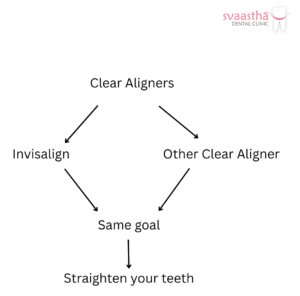
Invisalign is a type of clear aligner.
Think of it like this.
If someone asks whether they should buy a Nike shoe or a sports shoe, the comparison isn’t quite right. Nike is a brand, while sports shoes are a category. There are many good brands that make sports shoes, each with its own features.
The same applies to teeth straightening.
Clear aligners are the category of treatment.
Invisalign is one well-known brand of clear aligners.
So the real question isn’t:
“Are Invisalign and clear aligners different?”
The better question is:
“Is Invisalign worth choosing over other clear aligner systems for my teeth?”
The answer depends on your smile, your bite, your treatment goals, and how complex your case is.
This guide will help you understand the differences in simple language so you can make an informed decision.
The Quick Answer
If you’re comparing Invisalign vs Clear Aligners, here’s the short answer:
- Invisalign is one of the world’s best-known clear aligner systems.
- Clear aligners are the treatment category, and Invisalign is one brand within that category.
- Many high-quality clear aligner systems can produce excellent results for mild to moderate cases.
- For some complex cases, Invisalign may offer additional advantages.
- The success of your treatment depends more on careful diagnosis, treatment planning, and wearing your aligners consistently than on the brand name alone.
The best way to choose between Invisalign vs Clear Aligners is through a personalised dental examination—not by comparing advertisements or price alone.
What Are Clear Aligners?

Clear aligners are transparent, removable trays that gradually move your teeth into better positions without the need for metal brackets and wires.
You wear a series of custom-made aligners, with each set gently moving your teeth closer to their ideal position.
Because they’re removable, you can take them out while eating, brushing, and flossing, making them a popular choice for adults and teenagers.
If you’re new to aligner treatment and would like to understand how it works, who it’s suitable for, and what to expect, read our Complete Guide to Clear Aligners in Gurgaon.
So, What Is Invisalign?
Invisalign follows the same basic principle as other clear aligners.
It also uses a series of custom-made transparent trays to gradually move teeth.
The difference is that Invisalign is a specific clear aligner system developed using its own materials, digital planning software, and manufacturing process.
That’s why patients often hear Invisalign mentioned separately.
But it’s important to remember:
Not every clear aligner is Invisalign—but Invisalign is a clear aligner.
Understanding this simple difference helps avoid a lot of confusion when researching treatment options.
Why Is Invisalign So Well Known?
One reason is history.
Invisalign was among the first companies to make clear aligners widely available around the world. As more people started choosing invisible teeth straightening, the brand became extremely popular.
Over time, many people began using the word “Invisalign” to describe all clear aligners—even though many different systems are available today.
If you’re interested in learning more about the technology behind Invisalign, you can visit the official Invisalign website.
However, popularity alone shouldn’t decide your treatment.
Just because a brand is well known doesn’t automatically mean it’s the best choice for every individual.
Your smile is unique, and your treatment should be too.
Why Do People Compare Invisalign With Other Clear Aligners?
Most patients don’t ask this question because they’re interested in the technology.
They ask because they want to know one thing:
“If Invisalign costs more, am I getting something better?”
That’s a completely reasonable question.
The honest answer is:
Sometimes yes. Sometimes no.
It depends on your individual case.
If your teeth need relatively simple correction, several high-quality clear aligner systems may achieve excellent results.
If your case is more complex, certain aligner systems may offer advantages that make the additional investment worthwhile.
The goal isn’t to find the “best” brand.
The goal is to find the most suitable treatment for your smile.
How Is Invisalign Different From Other Clear Aligners?
Although all clear aligners work on the same basic principle, there are differences between systems.
These differences don’t mean one is always better than another, but they may influence which option is recommended for a particular patient.
1. The Material
Not all aligners are made from exactly the same material.
Some are slightly firmer, while others are more flexible.
The material can influence comfort, fit, and how gently the aligners move your teeth.
For most patients, this isn’t something they’ll notice every day, but it can play a role in the overall treatment experience.
2. Digital Treatment Planning
Before treatment begins, your dentist creates a digital plan showing how your teeth are expected to move throughout treatment.
Modern aligner systems use advanced software to help visualise these movements before the first aligner is even made.
However, there’s something many patients don’t realise.
The software creates the plan—but the dentist decides the plan.
Even the most advanced technology cannot replace careful diagnosis, clinical judgement, and experience.
Think of it like using GPS while driving.
The GPS can suggest a route, but the driver still decides how to deal with traffic, diversions, and unexpected situations.
Similarly, digital software is an excellent tool, but successful treatment depends on accurate diagnosis, proper planning, and regular monitoring. The American Association of Orthodontists also emphasises the importance of professional supervision throughout orthodontic treatment.
3. The Types of Cases They Can Treat
Not every smile presents the same challenge.
Some people simply want to straighten one or two slightly crooked front teeth.
Others may have:
- Rotated teeth
- Gaps between teeth
- Bite problems
- Teeth that haven’t erupted or moved into the correct position
As treatment becomes more complex, planning becomes even more important.
Certain aligner systems include features that may provide additional control for more challenging tooth movements.
That doesn’t mean every patient needs those features.
For many mild to moderate cases, other well-designed clear aligner systems can achieve excellent results when treatment is carefully planned and monitored.
One Thing Patients Often Overlook
Many people spend hours comparing aligner brands online.
Very few spend time comparing how their treatment will actually be planned.
That’s like choosing a paintbrush before deciding what you’re going to paint.
The brand of aligner matters.
But the treatment plan matters even more.
A Conversation We Have Almost Every Day
One question we frequently hear during consultations is:
“Doctor, which aligner is the best?”
Instead of answering immediately, we usually ask a few questions first.
- What would you like to change about your smile?
- Are you mainly concerned about appearance, or are you also having difficulty biting or chewing?
- Have you had braces before?
- How important is treatment time?
- Are you looking for the most advanced option, or the one that offers the best balance between results and cost?
Only after understanding these answers do we discuss which aligner system may be the most suitable.
Because choosing an aligner shouldn’t begin with the brand.
It should begin with your smile.
If you’re still deciding whether invisible aligners or braces are a better choice for you, our detailed comparison of Clear Aligners vs Braces explains the advantages and limitations of both treatments.
If you’d like to understand how we evaluate each patient before recommending treatment, you can learn more about our Clear Aligner Treatment.
Is Invisalign Always Better Than Other Clear Aligners?
This is probably the biggest misconception about Invisalign vs clear aligners.
Many patients believe that because Invisalign is more expensive and more widely recognised, it must automatically produce better results.
The truth is a little more nuanced.
Think of it like this.
Owning the most expensive camera doesn’t automatically make someone a great photographer. The final photograph still depends on the person using the camera.
Similarly, even the most advanced aligner system depends on careful diagnosis, treatment planning, regular monitoring, and how well the patient follows instructions.
For many people with mild to moderate alignment problems, other high-quality clear aligner systems can produce excellent results when used appropriately.
On the other hand, for certain complex cases, Invisalign may offer advantages that make it the preferred option.
The important thing is not choosing the biggest brand—it’s choosing the treatment that’s best suited to your smile.
Invisalign vs Clear Aligners: When Is Invisalign Worth the Extra Cost?
There isn’t a single answer that applies to everyone.
After carefully examining your teeth, bite, and smile goals, your dentist may recommend Invisalign if it offers a genuine advantage for your particular case.
Some situations where Invisalign may be considered include:
- More complex tooth movements
- Certain bite corrections
- Cases that may benefit from highly detailed digital treatment planning
- Patients who prefer a globally recognised aligner system with a long clinical track record
Choosing Invisalign doesn’t automatically mean you’ll get a better smile than someone using another clear aligner system.
It simply means that, for some patients, its technology may make treatment more predictable or efficient.
That’s why treatment recommendations should always be based on a clinical examination—not advertisements, social media, or online reviews.
When Other Clear Aligners Can Be an Excellent Choice
One of the biggest myths in dentistry is that only the most expensive treatment produces the best results.
In reality, that’s often not the case.
Many patients with mild to moderate crowding or spacing achieve excellent results with other high-quality clear aligner systems.
If the diagnosis is accurate, the treatment plan is carefully designed, and the aligners are worn as instructed, different aligner systems can successfully create healthy, confident smiles.
That’s why we don’t believe every patient needs the same aligner brand.
Instead, we believe every patient deserves the treatment that’s most appropriate for their individual needs.
Invisalign vs Clear Aligners: What Matters More Than the Brand?

If we had to choose the single biggest factor that influences the success of aligner treatment, it wouldn’t be the brand of aligner.
It would be the treatment plan.
Patients often spend hours comparing aligner brands online but very little time understanding how their teeth will actually be moved.
In reality, successful treatment depends on several important factors working together.
A Correct Diagnosis
Before recommending any aligner system, it’s important to understand the actual problem.
Are the teeth crowded?
Is there a bite issue?
Have the teeth shifted after previous braces?
Understanding the cause helps determine the most appropriate treatment. Choosing an aligner brand comes later.
Careful Treatment Planning
Every tooth needs to move in a controlled and safe manner.
Moving teeth too quickly—or in the wrong sequence—can affect the final result.
A good treatment plan considers not only how your smile will look but also how your teeth will function together after treatment.
Patient Cooperation
Even the best aligners cannot work if they aren’t worn consistently.
Most aligner systems need to be worn for 20–22 hours every day to achieve the planned tooth movements.
Removing them too often or forgetting to wear them can delay treatment and affect the final outcome.
If you’re curious about how missed wear time affects treatment, read our guide on What Happens If You Don’t Wear Your Aligners?
Regular Follow-Up
Teeth don’t always move exactly as predicted.
Regular review appointments allow your dentist to monitor progress and make adjustments whenever necessary.
Sometimes, small changes or additional aligners may be required to achieve the desired result.
To understand why these adjustments are sometimes needed, read our article on Attachments and Refinements in Clear Aligner Treatment. Professional supervision remains one of the most important parts of successful aligner treatment.
Invisalign vs Other High-Quality Clear Aligners: A Simple Comparison
| Feature | Invisalign | Other High-Quality Clear Aligners |
|---|---|---|
| Type | A specific clear aligner brand | A category with several established systems |
| Appearance | Nearly invisible | Nearly invisible |
| Removable | ✔ | ✔ |
| Comfortable to wear | ✔ | ✔ |
| Digital treatment planning | Advanced | Available in many modern systems |
| Suitable for mild cases | ✔ | ✔ |
| Suitable for moderate cases | ✔ | ✔ |
| Suitable for more complex cases | May offer advantages in selected situations | Depends on the aligner system and the individual case |
| Cost | Usually higher | Often more affordable |
| Best choice | Depends on your individual treatment needs | Depends on your individual treatment needs |
Notice something interesting?
The final row is exactly the same.
That’s because there isn’t one aligner system that’s perfect for everyone.
What Nearly Two Decades of Treating Patients Has Taught Me About Clear Aligners
One thing I’ve noticed over the years is that many patients walk into the clinic expecting me to recommend the most expensive treatment.
Sometimes they’re surprised when I don’t.
That’s because my recommendation isn’t based on the brand—it’s based on what’s most appropriate for the person sitting in front of me.
I’ve seen patients achieve beautiful, confident smiles with different clear aligner systems because the treatment was carefully planned and they followed instructions consistently.
I’ve also seen situations where a more advanced aligner system was genuinely the better choice because of the complexity of the tooth movement.
Every smile is different.
That’s why I believe the best treatment isn’t determined by the logo on the aligner box.
It’s determined by careful diagnosis, thoughtful planning, and choosing the right solution for each individual patient.
How Do We Decide Which Aligner System to Recommend?
When patients ask, “Which aligner is the best?”, we don’t begin by talking about brands.
We begin by understanding the patient.
We ask questions like:
- What would you like to improve about your smile?
- How much tooth movement is actually required?
- Is your bite involved?
- Have you had braces before?
- What are your treatment goals?
- What option is likely to provide the healthiest and most stable long-term result?
Only after answering these questions do we discuss which aligner system may be most suitable.
Because dentistry isn’t about recommending the most expensive treatment.
It’s about recommending the most appropriate one.
Choosing the Right Option for You
If you’re trying to decide between Invisalign and other clear aligners, here’s a simple guide.
| You may benefit from… | If… |
|---|---|
| Invisalign | Your case involves more complex tooth movements or your dentist believes its features offer a clear advantage. |
| Another high-quality clear aligner system | Your alignment concerns are mild to moderate, and a different system can achieve the same result effectively. |
| Either option | The final decision depends on a detailed clinical examination, your treatment goals, and professional advice—not just the brand name. |
At the end of the day, the goal isn’t to choose the most famous aligner.
The goal is to choose the treatment that gives you a healthy bite, a confident smile, and a result that lasts.
If you’re considering invisible teeth straightening and would like to understand which option is best for your smile, learn more about our Clear Aligner Treatment or schedule a consultation with Dr. Arjita Sood.
Final Thoughts: Invisalign vs Clear Aligners – Which Should You Choose?
If you’ve read this far, you’ve probably realised that there isn’t a single answer that works for everyone.
That’s because Invisalign vs clear aligners isn’t really about deciding which brand is “better.”
It’s about understanding which treatment is better for you.
For some patients, Invisalign may offer advantages because of the nature of their tooth movements or treatment goals.
For others, another high-quality clear aligner system may achieve the same healthy, attractive result without the need for a premium-priced option.
The important thing is not choosing the most popular aligner.
It’s choosing the treatment that’s based on a proper diagnosis, careful planning, and realistic expectations.
After all, the aligners move your teeth—but the treatment plan guides the journey.
If you’re considering invisible teeth straightening and aren’t sure which option is right for you, the best next step is a professional consultation where your smile, bite, and treatment goals can be evaluated.
At Svaastha Dental Clinic & Implant Center, Sector 23 Gurgaon, we believe in recommending the treatment that’s most appropriate for your individual needs—not simply the most expensive one.
Whether that involves Invisalign or another high-quality clear aligner system, our goal remains the same:
A healthy bite, a confident smile, and results that last.
In some patients, straightening the teeth alone creates the desired smile. In others, aligners may be combined with treatments such as Smile Designing to improve the shape, colour, or proportions of the teeth after alignment is complete.
Many patients also choose Professional Teeth Whitening after completing their aligner treatment to enhance their final smile.
To learn more about our Clear Aligner Treatment or to schedule a consultation, we’d be happy to guide you through your options.
Frequently Asked Questions
When comparing Invisalign vs Clear Aligners, is Invisalign always better?
Not necessarily.
Invisalign offers several advanced features and has a long history of clinical use. However, many other high-quality clear aligner systems can also produce excellent results when the case is suitable and treatment is carefully planned.
Is Invisalign worth the extra cost?
For some patients, yes.
If your case involves more complex tooth movements or your dentist believes Invisalign offers a clear advantage, the additional investment may be worthwhile.
For many mild to moderate cases, other high-quality clear aligners may also provide excellent results.
Can other clear aligners achieve the same results as Invisalign?
In many cases, yes.
The final outcome depends on several factors, including the complexity of your teeth, the treatment plan, and how consistently you wear your aligners.
How do I know whether Invisalign or another clear aligner is right for me?
The only reliable way is through a clinical examination.
Your dentist will assess your teeth, bite, oral health, and treatment goals before recommending the aligner system that’s most suitable for your case.
Are clear aligners suitable for teenagers?
Many teenagers are suitable candidates for clear aligners, provided they wear them consistently.
The right option depends on their stage of dental development and the type of tooth movement required.
Can adults choose either Invisalign or other clear aligners?
Yes.
Adults with healthy teeth and gums are often excellent candidates for clear aligner treatment.
The decision between Invisalign and another aligner system depends on the complexity of the case and individual treatment goals.
Is Invisalign faster than other clear aligners?
Treatment time depends more on the complexity of your case and how consistently you wear your aligners than on the brand itself.
Some cases may finish quickly, while others require more time regardless of the aligner system used.
Will people notice I’m wearing clear aligners?
Clear aligners are designed to be discreet.
Most people won’t notice them during normal conversations unless they’re looking very closely.
Conclusion
Choosing between Invisalign vs clear aligners doesn’t have to be confusing.
The best treatment isn’t determined by advertisements, social media, or price alone.
It’s determined by understanding your smile, your bite, and your long-term oral health.
If you’re looking for clear aligner treatment in Gurgaon and would like honest, personalised advice, book a consultation with Dr. Arjita Sood at Svaastha Dental Clinic & Implant Center.
Together, we’ll help you choose the treatment that’s right for your smile.
About Dr. Arjita Sood
This article has been written and medically reviewed by Dr. Arjita Sood, founder of Svaastha Dental Clinic & Implant Center, Sector 23 Gurgaon.
Since 2010, she has been helping patients make informed decisions about their oral health through ethical, evidence-based dentistry. Her approach focuses on understanding each patient’s individual needs and recommending the treatment that is most appropriate—not simply the most expensive.
Her clinical interests include clear aligner treatment, smile rehabilitation, dental implants, and preventive dentistry. The aim of these articles is simple—to help patients understand their treatment options in clear, easy-to-understand language so they can make informed decisions about their oral health.