
Wisdom Tooth Removal: Quick Answer
Wisdom tooth removal is recommended when a wisdom tooth is causing pain, repeated infection, significant decay, gum disease, damage to a neighboring tooth, a cyst or other dental problems—or when its position makes future problems likely and removal is considered appropriate after examination.
Not every wisdom tooth needs to be removed. A wisdom tooth that has erupted normally, is healthy, functional, easy to clean and free from disease may sometimes be monitored rather than extracted. Your dentist usually evaluates the tooth clinically and may recommend an X-ray to understand its position and relationship to the surrounding teeth and structures.
If you have pain or swelling at the very back of your mouth, repeated gum swelling, food getting trapped around a wisdom tooth, bad taste or bad breath, difficulty opening your mouth, or discomfort around the neighboring molar, it is worth getting the area examined rather than simply waiting for the pain to disappear.
What Is a Wisdom Tooth?
Wisdom teeth are the third and last set of molars at the very back of your mouth. Most people have up to four—one in each corner of the mouth—but some people have fewer or do not develop wisdom teeth at all.
They usually begin to erupt during the late teenage years or early twenties, commonly between 17 and 25 years of age. However, they can cause problems later in life as well.
Because wisdom teeth are located so far back in the mouth, they can sometimes be difficult to brush and floss properly. If there isn’t enough room for them to erupt normally, they may remain partially or completely trapped underneath the gum or jawbone.
This is called an impacted wisdom tooth.
Do You Have to Remove All Four Wisdom Teeth?
No.
The presence of a wisdom tooth does not automatically mean that it needs to be extracted.
Some wisdom teeth erupt into a useful position and remain healthy throughout life. Others may be partially erupted, tilted, trapped under the gum or bone, or positioned in a way that makes them difficult to keep clean.
The decision should therefore be based on the condition and position of the individual tooth, rather than simply on whether it is a wisdom tooth.
If a wisdom tooth is healthy and functioning normally, your dentist may recommend keeping it and monitoring it during regular dental examinations.
What Is an Impacted Wisdom Tooth?
An impacted wisdom tooth is a tooth that cannot erupt into its normal position because it is blocked by another tooth, bone, gum tissue or lack of space.
Impaction can be:
1. Partially erupted
Part of the tooth has come through the gum, while the rest remains covered.
This can create a small pocket around the tooth where food and bacteria become trapped, making the area difficult to clean.
2. Completely impacted
The tooth remains completely underneath the gum and/or jawbone and may not be visible in the mouth.
3. Angled or sideways
The wisdom tooth may be tilted toward the neighboring molar rather than growing vertically.
A horizontally or significantly tilted wisdom tooth can place pressure on the tooth in front of it and may increase the risk of decay, gum problems or other complications.
4. Normally positioned but difficult to clean
A wisdom tooth does not have to be impacted to cause problems.
Even a fully erupted wisdom tooth can become problematic if its position makes brushing and flossing difficult or if food repeatedly becomes trapped around it.
Why Do Wisdom Teeth Become Impacted?
The most common reason is lack of adequate space in the jaw for the tooth to erupt normally.
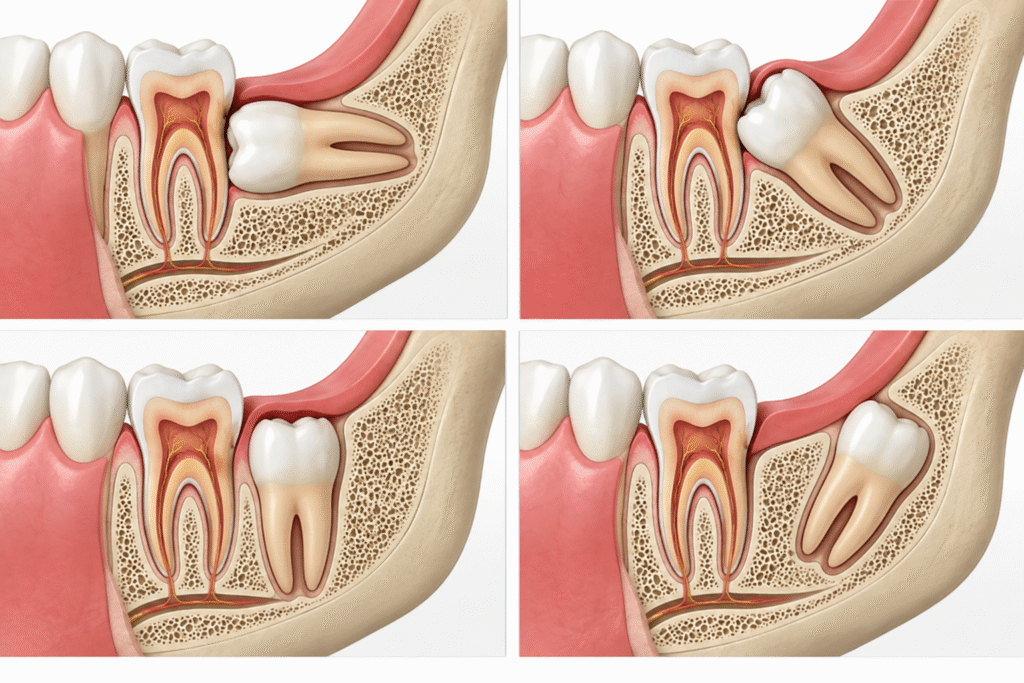
Sometimes the wisdom tooth develops at an angle and becomes blocked by the second molar. In other cases, the tooth may be positioned normally but remain covered by gum or bone.
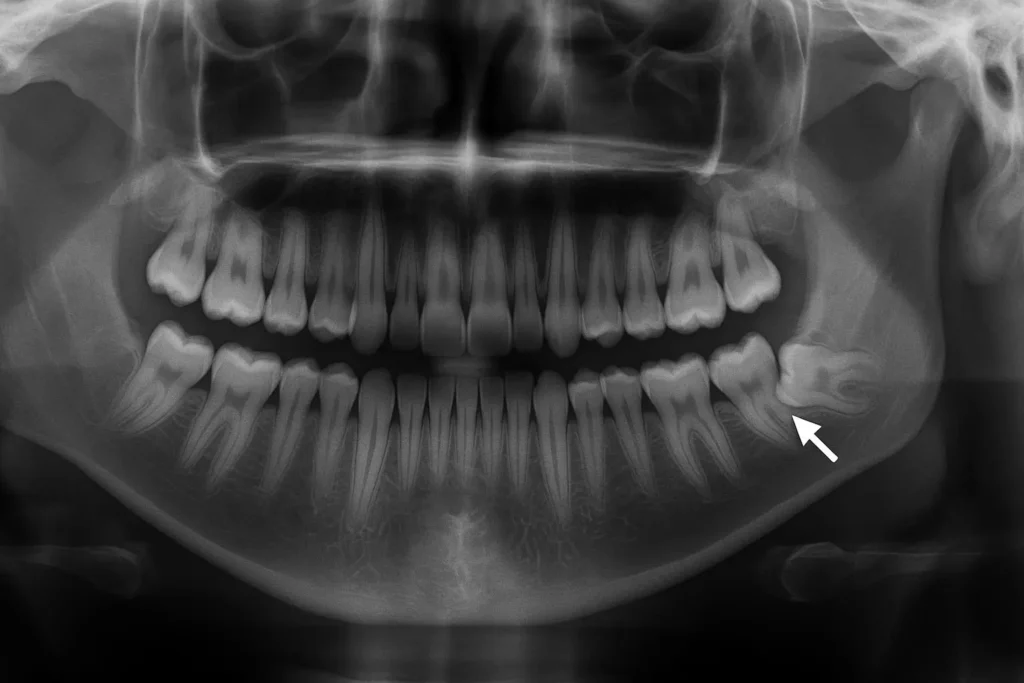
The position of a wisdom tooth can be understood much better with a dental X-ray than by simply looking inside the mouth. Your dentist may recommend a panoramic X-ray (OPG) to assess the wisdom tooth, its roots, the neighboring tooth and surrounding bone.
Wisdom Tooth Symptoms: How Do You Know There Is a Problem?
A wisdom tooth can cause symptoms suddenly, gradually, or sometimes no symptoms at all.
Common warning signs include:
- Pain or pressure at the back of the mouth
- Swollen or tender gum around the wisdom tooth
- Red or bleeding gum tissue
- Pain while chewing
- Food repeatedly getting stuck around the tooth
- Bad taste in the mouth
- Persistent bad breath
- Difficulty opening the mouth fully
- Swelling of the jaw or cheek
- Pain around the neighboring molar
- Repeated episodes of pain or gum swelling
These symptoms can occur when a wisdom tooth becomes difficult to clean, partially erupts, becomes infected, or develops decay or gum disease.
Can Wisdom Tooth Pain Cause Jaw or Ear Pain?
It can.
Pain from the back of the jaw may sometimes radiate into nearby areas, making it feel as though the discomfort is coming from the jaw, face or even the area around the ear.
However, not every jaw or ear pain is caused by a wisdom tooth. Temporomandibular joint problems, ear conditions, cavities and other dental problems can produce similar symptoms.
That is why an examination is important rather than assuming that every pain at the back of the mouth is a wisdom tooth problem.
What Is Pericoronitis?
If a wisdom tooth has erupted only partially, a flap of gum may remain over part of the tooth.
This area can become difficult to clean, allowing bacteria and food debris to accumulate. Good oral hygiene and professional cleaning can help maintain gum health around difficult-to-clean areas.
The resulting inflammation or infection of the gum around a partially erupted wisdom tooth is called pericoronitis.
You may notice:
- pain around the back tooth
- swollen gum
- tenderness
- bad taste
- bad breath
- difficulty chewing
- difficulty opening the mouth
Pericoronitis can sometimes settle temporarily and then return. Repeated episodes may be a reason to assess whether the wisdom tooth should be removed.
Important: antibiotics may sometimes be needed when there is significant infection, but they do not correct the underlying position of a problematic wisdom tooth. The long-term treatment depends on the cause and severity of the problem.
Can Wisdom Tooth Pain Go Away on Its Own?
Yes, the pain can sometimes settle temporarily—but that does not necessarily mean the underlying problem has disappeared.
Wisdom tooth symptoms can come and go, particularly when inflammation around a partially erupted tooth settles.
For example, a gum infection around a wisdom tooth may improve for a while, only to flare up again later.
If the tooth remains difficult to clean, repeatedly traps food, is significantly impacted or is causing damage to the neighboring tooth, simply waiting for the pain to disappear does not address the underlying cause.
On the other hand, pain disappearing does not automatically mean that the wisdom tooth needs to be removed either. Some wisdom teeth can be safely monitored if they are healthy and not causing disease.
The important question is therefore not just:
“Does it hurt?”
but:
“What is happening around the wisdom tooth, and is the tooth healthy and maintainable?”
That distinction is particularly important when deciding whether removal is actually necessary.
What Happens If You Ignore a Problematic Wisdom Tooth?
Ignoring recurring wisdom tooth symptoms can allow an underlying problem to continue or worsen.
Depending on the position and condition of the tooth, problems can include:
- repeated gum infections
- tooth decay
- gum disease around the wisdom tooth
- decay or damage to the neighboring second molar
- dental abscess
- cyst formation in some cases
- persistent pain or swelling
- difficulty maintaining oral hygiene around the area
An impacted tooth does not automatically mean that these complications will occur. The actual risk depends on its position, surrounding tissues, oral hygiene and whether there is already evidence of disease.
This is why a wisdom tooth that is causing repeated problems should be evaluated rather than repeatedly managing the pain without finding the cause.
Does an Impacted Wisdom Tooth Always Need to Be Removed?
No.
This is one of the most important points to understand about wisdom teeth.
An impacted wisdom tooth that is healthy, symptom-free and not causing damage may sometimes be monitored rather than immediately removed. If removal is recommended after examination, the procedure may range from a straightforward extraction to a more complex surgical extraction depending on the position of the tooth.
Monitoring usually involves:
- regular dental examinations
- checking the surrounding gum
- maintaining good oral hygiene
- periodic X-rays when clinically appropriate
- watching for changes in the tooth or neighboring structures
On the other hand, removal may become appropriate when there is evidence of infection, significant gum disease, non-restorable decay, cystic or other pathology, or damage to an adjacent tooth.
So the decision is not simply:
“Impacted = remove.”
It is:
“What is the position and condition of this tooth, and what is the safest long-term option?”
How Does a Dentist Decide Whether Your Wisdom Tooth Needs Removal?
The decision usually starts with a clinical examination.
Your dentist will assess:
- where the wisdom tooth is positioned
- whether it has erupted fully or partially
- whether the surrounding gum is healthy
- whether food is getting trapped
- whether there is decay
- whether the neighboring tooth is affected
- whether there has been previous infection or swelling
- how easily the area can be maintained with normal brushing and flossing
An X-ray is often useful because much of a wisdom tooth may be hidden beneath the gum or bone.
A panoramic X-ray (OPG) can provide an overall view of the wisdom teeth, their roots, neighboring teeth and surrounding bone. In selected cases, a 3D CBCT scan may be recommended when more detailed information is needed for treatment planning.
We will discuss when an OPG or CBCT is needed, how dentists assess the risk of removal, and when a wisdom tooth can be monitored instead of extracted in the next part.
Wisdom Tooth Pain: When Should You See a Dentist?
You should arrange a dental examination if you have:
- recurring pain at the back of your mouth
- swelling around a wisdom tooth
- repeated gum infections
- difficulty opening your mouth
- persistent bad taste or bad breath
- food repeatedly getting trapped around the tooth
- pain around the neighboring molar
- swelling of your cheek or jaw
Seek urgent dental care if swelling is rapidly increasing, you have significant difficulty swallowing or breathing, or you feel severely unwell. These symptoms can indicate a more serious infection requiring prompt assessment.
How Is a Wisdom Tooth Removal Planned?
Once a wisdom tooth has been identified as potentially requiring removal, the next step is to determine how difficult the extraction is likely to be and how it can be performed safely.
The dentist considers several factors, including:
- whether the tooth is fully or partially erupted
- its position and angle
- how deeply it is embedded
- the shape and number of its roots
- the condition of the surrounding bone
- the health of the neighboring second molar
- whether there is infection or inflammation
- and, for lower wisdom teeth, how close the roots are to important nerves
This assessment helps determine whether the tooth can be removed with a simple extraction or whether a surgical extraction is more appropriate.
It also helps the dentist decide what imaging, anaesthesia and treatment approach may be needed.
What X-Ray Is Needed Before Wisdom Tooth Removal?
A dental X-ray is an important part of planning many wisdom tooth removals because the position of the tooth and its roots cannot always be fully assessed by looking inside the mouth.
What Is an OPG?
An OPG (orthopantomogram), or panoramic X-ray, provides a broad view of both jaws and is commonly used to assess wisdom teeth.
It can show:
- the position of the wisdom tooth
- whether it is impacted
- the direction in which it is growing
- the depth of the tooth
- the shape and position of its roots
- the neighboring second molar
- surrounding bone
- and the approximate relationship of a lower wisdom tooth to the nerve canal
An OPG is often enough for initial treatment planning.
When Is a CBCT Scan Needed for Wisdom Tooth Removal?
A CBCT (Cone Beam Computed Tomography) provides a three-dimensional view of the tooth and surrounding structures.
It is not routinely required for every wisdom tooth.
Your dentist may recommend a CBCT when a conventional X-ray does not provide enough information for treatment planning—for example, when the roots of a lower wisdom tooth appear to be very close to the inferior alveolar nerve.
The additional 3D information can help the dentist understand the exact relationship between the tooth roots, bone and surrounding structures.
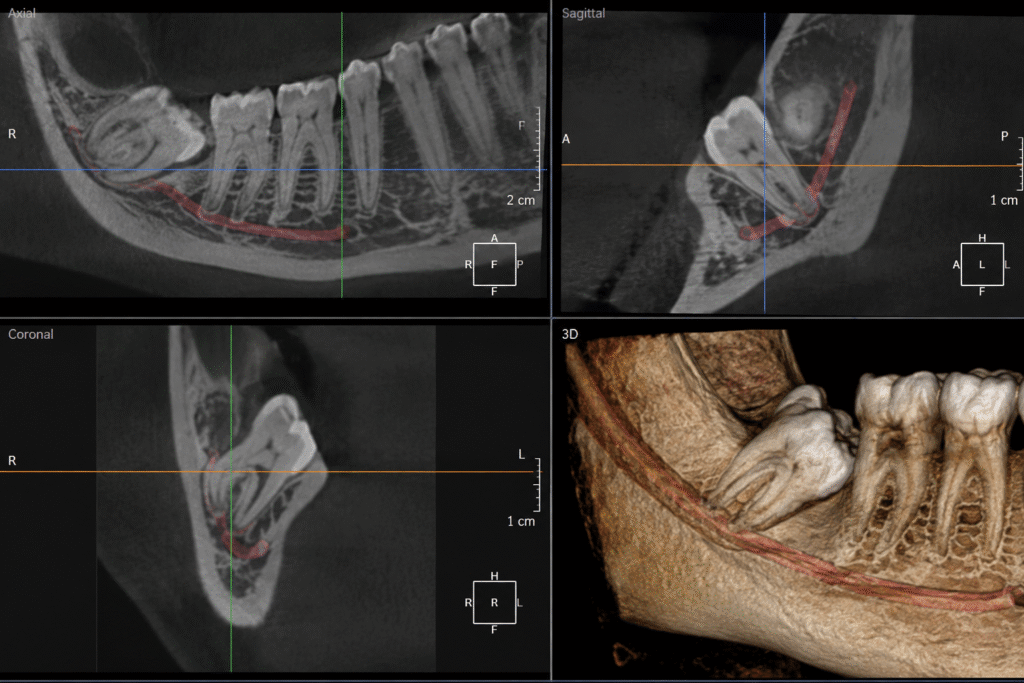
This can be particularly useful when deciding between complete removal and alternative approaches such as coronectomy in selected cases.
The decision to take a CBCT should therefore be based on the individual tooth and the information needed for safe treatment planning.
What Is a Simple Wisdom Tooth Extraction?
A wisdom tooth that has erupted sufficiently and can be accessed easily may sometimes be removed through a simple extraction.
After numbing the area with local anaesthesia, the dentist gently loosens the tooth and removes it using appropriate instruments.
The procedure is generally more straightforward when:
- the tooth is fully erupted
- there is adequate access
- the tooth has a favorable position
- and the roots can be removed without significant surgical intervention.
However, even an erupted wisdom tooth can occasionally require a surgical approach if its roots, position or surrounding bone make removal more complicated.
What Is Surgical Wisdom Tooth Removal?
When a wisdom tooth is impacted or difficult to access, a surgical extraction may be required.
Depending on the position of the tooth, the procedure may involve:
- Numbing the area with local anaesthesia
- Making a small opening in the gum
- Removing a small amount of bone around the tooth when necessary
- Dividing the tooth into smaller sections if required
- Removing the tooth or its sections
- Cleaning the area
- Placing stitches when appropriate
Not every surgical extraction requires all of these steps.
The technique is selected according to the position, depth, roots and surrounding anatomy of the individual tooth.
Does Wisdom Tooth Removal Hurt?
The removal itself should not be painful when adequate local anaesthesia has been achieved.
You may feel:
- pressure
- pushing
- pulling
- movement of the tooth
- vibration from instruments
- stretching of the gum
These sensations are normal.
You should not, however, have to tolerate significant sharp pain during the procedure. If you feel pain, tell your dentist so that additional anaesthesia can be given before continuing.
What Happens After the Anaesthesia Wears Off?
Some pain, swelling and jaw stiffness are expected after wisdom tooth removal, particularly after a surgical extraction.
The amount of discomfort varies depending on:
- how deeply the tooth was impacted
- whether bone had to be removed
- whether the tooth had to be divided
- whether it was an upper or lower wisdom tooth
- and your individual healing response
We will cover what happens after the extraction—including pain, swelling, food, brushing, exercise, work and warning signs—in Part 3.
How Long Does Wisdom Tooth Removal Take?
There is no fixed duration for wisdom tooth removal.
A fully erupted tooth in an accessible position may be removed relatively quickly, while a deeply impacted wisdom tooth may require more surgical time.
The duration depends on:
- tooth position
- depth of impaction
- root shape
- amount of surrounding bone
- access to the tooth
- whether the tooth needs to be sectioned
- and the complexity of the individual case.
So rather than judging the procedure by a fixed number of minutes, it is more useful to understand how complex the particular wisdom tooth is.
Local Anaesthesia vs Sedation for Wisdom Tooth Removal
Most wisdom tooth removals can be performed under local anaesthesia.
Local anaesthesia makes the treatment area numb while you remain awake.
For patients with significant dental anxiety or for certain procedures, sedation may sometimes be considered depending on the clinical situation and available facilities.
Sedation is different from local anaesthesia:
- Local anaesthesia prevents pain from the treatment area.
- Sedation helps reduce anxiety and improve comfort.
Your dentist will determine what is appropriate based on the procedure, your anxiety level, medical history and the treatment setting.
Is Lower Wisdom Tooth Removal More Complicated Than Upper?
It can be, although every wisdom tooth is different.
Lower wisdom teeth are more likely to become significantly impacted because of the limited space at the back of the lower jaw.
Another important consideration is the inferior alveolar nerve, which runs through the lower jaw and provides sensation to the lower lip and chin.
In some patients, the roots of a lower wisdom tooth may lie close to this nerve.
This does not mean that lower wisdom tooth removal is inherently dangerous.
It means that when the tooth appears close to the nerve, careful imaging and treatment planning become particularly important.
This is also where options such as coronectomy may be considered in selected cases.
What Is a Coronectomy?
A coronectomy is a procedure in which the crown of a lower wisdom tooth is removed while the roots are intentionally left in place.
It may be considered in selected cases where the roots of an impacted lower wisdom tooth are very close to an important nerve and complete removal could carry a higher risk of nerve injury.
The roots are not simply left behind in every difficult extraction. Coronectomy has specific indications and is only appropriate in selected situations after careful assessment.
Can Two or Four Wisdom Teeth Be Removed at Once?
Yes, multiple wisdom teeth can sometimes be removed during the same appointment.
However, removing all four is not automatically necessary simply because all four are present.
The decision depends on:
- whether each tooth actually requires treatment
- the complexity of each extraction
- your overall dental condition
- expected recovery
- your preferences
- and the clinician’s treatment plan
For example, if one wisdom tooth is repeatedly infected while the other three are healthy and suitable for monitoring, there may be no reason to remove all four.
Is It Better to Remove Wisdom Teeth Early?
There is no universal age at which every wisdom tooth should be removed.
If a wisdom tooth has a clear indication for removal, your dentist may recommend treating it before the problem becomes more complicated.
However, age alone is not a sufficient reason to remove a healthy wisdom tooth.
The decision should be based on the condition and position of the tooth, the surrounding anatomy and the balance between the expected benefits and risks of treatment.
What Happens After Wisdom Tooth Removal?
Once the wisdom tooth has been removed, a blood clot forms inside the extraction socket. This clot is an important part of normal healing because it protects the underlying tissues while the area begins to repair.
Some pain, swelling, mild bleeding, bruising and jaw stiffness are normal after wisdom tooth removal, particularly when the tooth has been surgically removed. Symptoms are generally most noticeable during the first few days and then gradually improve.
Your recovery will depend on how difficult the extraction was, whether bone had to be removed, whether the tooth was sectioned, and your individual healing response.
Wisdom Tooth Removal Recovery: What to Expect
First 24 hours
The area may feel numb initially because of the local anaesthetic.
Once the numbness wears off, you may experience:
- soreness around the extraction site
- mild bleeding or blood-stained saliva
- swelling beginning to develop
- difficulty chewing
- some jaw stiffness
A soft diet is usually more comfortable during this period. Avoid very hot foods and drinks while the area is numb, and follow the specific instructions given by your dentist.
Days 2–3
This is often when swelling and discomfort are most noticeable.
You may also find that opening your mouth widely is uncomfortable.
This does not necessarily mean something is wrong. Swelling and jaw stiffness commonly improve over the following days.
Days 4–7
For most patients, pain and swelling should gradually start settling.
You can usually begin returning to a more normal diet as chewing becomes comfortable, although harder or crunchy foods may still be best avoided around the extraction site.
After the first week
Many patients are able to return to their normal routine, although the extraction site itself continues healing beneath the gum.
After a more difficult surgical extraction, it can take longer for the area to feel completely normal.
How Long Does Wisdom Tooth Removal Pain Last?
Pain is usually most noticeable during the first few days and should gradually improve rather than become increasingly severe.
The exact duration depends on the complexity of the extraction.
A simple extraction may cause relatively little discomfort, while a deeply impacted lower wisdom tooth requiring bone removal and tooth sectioning may result in more soreness and stiffness.
The important thing is the direction of recovery.
If your pain is gradually becoming better, that is generally reassuring.
If pain becomes significantly worse several days after the extraction, particularly if it is accompanied by a bad taste or bad breath, you should contact your dentist because this can be a sign of dry socket.
How Long Does Swelling Last After Wisdom Tooth Removal?
Swelling is common after surgical wisdom tooth removal.
It is often most noticeable around days 2–3 and then gradually improves. Some residual swelling or bruising can last for a week or longer, particularly after a difficult extraction.
A useful way to think about it is:
Day 1 → swelling begins
Days 2–3 → often most noticeable
Days 4–7 → gradually improves
After 1 week → usually substantially better
However, individual recovery varies.
If swelling continues to increase rather than improve, particularly when accompanied by fever, worsening pain or feeling unwell, contact your dentist.
What Can You Eat After Wisdom Tooth Removal?
For the first few days, choose soft foods that require minimal chewing.
Good options include:
- curd or yogurt
- khichdi
- soft dal and rice
- mashed vegetables
- soft idli
- porridge
- scrambled eggs
- soft pasta
- soup that has cooled to a comfortable temperature
- smoothies taken without a straw
As your mouth becomes more comfortable, gradually return to your normal diet.
What Should You Avoid?
Avoid foods that are:
- very hard
- crunchy
- sharp
- excessively spicy if they irritate the area
- very hot
- likely to become trapped in the extraction socket
Nuts, seeds and similar small hard foods can be particularly inconvenient because particles may lodge around the healing socket.
Can You Drink Tea or Coffee?
It is better to avoid very hot drinks during the early recovery period, particularly while the area is numb or the blood clot is still vulnerable.
Once the area has settled and your dentist’s instructions allow it, you can gradually return to your usual drinks.
Can You Brush Your Teeth After Wisdom Tooth Removal?
Yes, but be gentle.
You should continue maintaining oral hygiene rather than stopping toothbrushing completely.
During the first day, avoid disturbing the extraction site. From the following day, you can generally brush the other teeth carefully and clean around the area without directly traumatizing the socket. Your dentist may also recommend gentle rinsing according to the procedure performed.
Do not aggressively spit or rinse immediately after surgery because vigorous rinsing can disturb the blood clot.
Follow your dentist’s specific post-operative instructions if they differ based on your procedure.
Can You Smoke or Drink Alcohol After Wisdom Tooth Removal?
Smoking should be avoided during early healing because it can interfere with healing and increase the risk of complications such as dry socket.
Alcohol is also best avoided during the early recovery period, particularly while taking certain medications or while the extraction site is still healing.
Your dentist may give you a specific period of abstinence based on the complexity of your procedure.
When Can You Go Back to Work After Wisdom Tooth Removal?
For a straightforward extraction, many people can return to normal activities relatively quickly.
After a more difficult surgical extraction, a few days of reduced activity may be more comfortable, particularly if your work involves physical exertion.
Your recovery also depends on the type of work you do.
If your job involves heavy physical activity, frequent speaking or long hours away from easy access to food and medication, you may need more recovery time than someone working quietly at a desk.
Current clinical guidance commonly recommends allowing a few days after more involved wisdom tooth surgery, while simpler cases may allow a quicker return to normal activities.
Can You Exercise After Wisdom Tooth Removal?
It is generally sensible to avoid strenuous exercise immediately after the procedure.
Heavy exercise can increase blood pressure and may contribute to bleeding or discomfort around the extraction site.
For a straightforward extraction, you may be able to return to light activity relatively quickly. After surgical removal, your dentist may recommend waiting a few days before strenuous exercise.
What Is Dry Socket?
Dry socket, also called alveolar osteitis, occurs when the protective blood clot in the extraction socket is lost or does not remain in place during early healing.
Instead of steadily improving, the patient may develop increasing, often intense pain a few days after the extraction.
Other symptoms can include:
- unpleasant taste
- bad breath
- pain that may radiate toward the ear or jaw
- an extraction site that appears unusually empty
Dry socket is more commonly associated with lower wisdom tooth removal. Smoking can increase the risk.
What Should You Do If You Suspect Dry Socket?
Contact your dentist rather than trying to treat it yourself.
Treatment may involve cleaning or irrigating the area and placing a dressing to reduce pain. Antibiotics are not automatically required because dry socket itself is not simply a bacterial infection.
Is Bleeding Normal After Wisdom Tooth Removal?
A small amount of bleeding or blood-stained saliva can be normal during the early period after extraction.
If bleeding occurs, applying firm pressure with clean gauze for the period recommended by your dentist can help.
Persistent or heavy bleeding that does not settle with appropriate pressure requires dental attention.
Can Wisdom Tooth Removal Cause Nerve Damage?
This is an important concern, particularly with lower impacted wisdom teeth.
The roots of some lower wisdom teeth can lie close to nerves that provide sensation to the lower lip, chin or tongue.
If a nerve is irritated during surgery, temporary numbness, tingling or altered sensation can occur. In most cases where nerve disturbance occurs, it improves over time, although rarely it can persist.
The risk depends greatly on the individual anatomy and the relationship between the tooth roots and the nerve.
This is why appropriate imaging and careful treatment planning are important for lower wisdom teeth that appear close to the nerve.
When Should You Contact Your Dentist After Wisdom Tooth Removal?
Don’t simply assume that increasing symptoms are part of normal healing.
Contact your dentist if you develop:
- pain that becomes significantly worse after initially improving
- severe or persistent swelling
- fever or feeling unwell
- pus or unusual discharge
- persistent bad taste or bad breath with worsening pain
- bleeding that does not stop
- increasing difficulty opening your mouth
- persistent or new numbness or tingling
- difficulty swallowing or breathing
Severe or rapidly increasing facial swelling with difficulty swallowing or breathing requires urgent medical attention.
Wisdom Tooth Removal Cost in Gurgaon (2026)
The cost of wisdom tooth removal in Gurgaon can vary substantially because not every wisdom tooth extraction is equally complex.
As a broad 2026 Gurgaon market reference, published local pricing currently ranges from around ₹2,000–₹4,000 for a straightforward erupted wisdom tooth to approximately ₹8,000–₹15,000 for some full-bony impactions, with intermediate levels of surgical impaction falling between these ranges. Other Gurgaon clinics publish broader ranges for difficult surgical removals.
Rather than presenting one universal price, I recommend your article explain the cost by complexity:
| Type of wisdom tooth removal | Typical complexity | Approximate cost in Gurgaon* |
|---|---|---|
| Simple extraction | Fully erupted and accessible | ₹2,000–₹4,000 |
| Soft-tissue impaction | Mainly covered by gum | ₹4,000–₹7,000 |
| Partial bony impaction | Partly covered by bone | ₹6,000–₹10,000 |
| Full bony impaction | Deeply embedded in bone | ₹8,000–₹15,000+ |
Why Does Wisdom Tooth Removal Cost Vary?
The final fee can depend on:
- whether the tooth is erupted or impacted
- depth of impaction
- angle of the tooth
- root shape and anatomy
- upper vs lower wisdom tooth
- proximity to important nerves
- whether bone removal is required
- whether the tooth needs to be sectioned
- whether CBCT imaging is required
- complexity of the procedure
- type of anaesthesia or sedation used
This is why an accurate price is usually possible only after examining the tooth and reviewing the required X-ray.
What Should Be Included in the Cost?
When comparing prices between dental clinics, ask whether the quoted fee includes:
- consultation
- X-ray/OPG
- surgical procedure
- local anaesthesia
- sutures
- medications
- follow-up visit
- CBCT, if required
A lower initial quote is not necessarily cheaper if important components are billed separately.
Is Wisdom Tooth Removal Worth It?
When a wisdom tooth is causing repeated problems or damaging surrounding teeth, removing it can prevent ongoing pain and infection and protect the neighboring structures.
But removal is not automatically the right decision for every wisdom tooth.
A healthy wisdom tooth that is functioning normally and can be maintained may be monitored instead.
The goal should therefore not be:
“Remove every wisdom tooth.”
The goal should be:
“Identify which wisdom teeth are likely to cause problems and choose the safest, most appropriate treatment for that individual tooth.”
Frequently Asked Questions About Wisdom Tooth Removal
At What Age Should Wisdom Teeth Be Removed?
There is no universal age at which every wisdom tooth should be removed. Treatment depends on the tooth’s position, condition, symptoms and associated risks.
Is Wisdom Tooth Removal Painful?
The procedure is performed under local anaesthesia, so you should not feel sharp pain during removal. Some soreness and swelling afterward are expected, particularly after surgical extraction.
How Many Days Does Wisdom Tooth Removal Take to Heal?
Many patients can resume normal activities within a few days, but the extraction site continues healing for longer. More complex surgical extractions can require a longer recovery period.
Can I Remove Two or Four Wisdom Teeth Together?
Yes, multiple wisdom teeth can sometimes be removed during one appointment. Whether this is appropriate depends on the condition and complexity of each tooth.
Can a Wisdom Tooth Grow Back After Removal?
No. Once a permanent wisdom tooth has been completely removed, it does not grow back.
Can Antibiotics Cure a Wisdom Tooth Infection Permanently?
Antibiotics may be prescribed when there is an appropriate indication for treating an infection, but they do not correct an impacted or structurally problematic wisdom tooth. The underlying cause still needs to be assessed.
Can I Keep My Wisdom Tooth If It Doesn’t Hurt?
Sometimes. A healthy, symptom-free wisdom tooth may be monitored if it is not causing disease or damage and can be appropriately maintained.
Is Wisdom Tooth Extraction Different From Normal Tooth Extraction?
Yes. A fully erupted wisdom tooth may sometimes be removed like another tooth, while an impacted wisdom tooth may require a surgical procedure involving gum and bone access and, in some cases, sectioning of the tooth.
Do I Need a CBCT Before Wisdom Tooth Removal?
Not always. CBCT is generally considered when additional three-dimensional information is needed for treatment planning, particularly when a lower wisdom tooth appears close to an important nerve.
Can Wisdom Tooth Removal Damage the Nerve?
There is a risk of nerve disturbance with some lower wisdom teeth, especially when the roots are close to the nerve. Appropriate imaging and treatment planning help assess and manage this risk.
Wisdom Tooth Removal at Svaastha Dental Clinic & Implant Center, Gurgaon
At Svaastha Dental Clinic & Implant Center, Sector 23, Gurgaon, wisdom tooth treatment begins with understanding why the tooth is causing a problem and how complex its position is.
Depending on the case, treatment planning may involve clinical examination, dental X-rays and, when indicated, 3D imaging.
The treatment approach is then tailored to the individual tooth—whether that means monitoring, managing an infection, simple extraction or surgical removal.
Our approach is not to recommend extraction simply because a tooth is a wisdom tooth. The aim is to provide evidence-based treatment that balances the benefits of removal with the risks of keeping or removing the tooth.
Book a wisdom tooth consultation in Gurgaon →
The Bottom Line
Wisdom tooth removal is not automatically necessary just because a tooth is impacted.
The important questions are:
Is the tooth healthy?
Is it causing symptoms or disease?
Is it damaging the neighboring tooth?
Can it be maintained properly?
What does the X-ray show?
And what is the safest long-term option?
If removal is recommended, understanding the tooth’s position and complexity can help you know what to expect from the procedure, recovery and cost.
If you are experiencing wisdom tooth pain, swelling, repeated infection or difficulty opening your mouth, an examination can help determine whether the tooth needs treatment or can safely be monitored.
About the Author

Dr. Arjita Sood is a dentist at Svaastha Dental Clinic & Implant Center, Sector 23, Gurgaon, with a clinical focus on comprehensive dental care and patient-centered treatment planning.
This article is intended for general patient education and does not replace an individual dental examination or diagnostic imaging